WILDFLOWERS OF RISELEY PARISH
MARK POWELL
A good way to view this document is by downloading the pdf below,alternatively please scroll down for the full text.

|
The Wildflowers of Riseley Parish (edited March 2026).pdf Size : 249.107 Kb Type : pdf |
This document consists of two annotated lists. Immediately below is an unpublished list that I compiled in December 2000. Below that is a list of all the additional species which I have recorded during the period 2001 to 2025. I consider myself a reasonably diligent amateur botanist but not an expert. Some of the taxa recorded require a final check and the records will be scrutinised by the county botanical recorder before the records are finally submitted to the BSBI (Botanical Society of the British Isles) database. I would urge anyone using this document NOT to independently submit any of the records to any recording database. I welcome information about any potential additions or suspected errors, or any other relevant observations.
I intend to continue studying and recording the wild and naturalised plants of Riseley parish in 2026 and perhaps to produce some narrative commentary of the more interesting species and also of the significant changes to the species present and their abundance and distribution in the study area.
I would welcome any correspondence about the "Wildflowers of Riseley Parish ", including any tip-offs about potential additions.
Mark Powell, Christmas 2025
email markpowell222@btinternet.com
The Wildflowers of Riseley Parish
This is a list of ferns and higher plants recorded in Riseley during or before the year 2000.
Both English and Latin names are given for each plant. Nomenclature and the sequence of plants in the list follow Staces’s ‘New Flora of the British Isles’ 1991.
Following each plant’s names are its status and distribution in the parish. The terms used refer to Riseley and may not be consistent with any terms used for the same species in other areas. For example a plant described as rare indicates that it has only rarely been found in Riseley, it may be common elsewhere. The following terms have been used throughout, with the following meanings.
Status
Native May have been present since prehistoric times.
British Native to other parts of the British Isles but arrived in Riseley within historical times, usually through human activity.
Adventive A foreign species which arrived here by inadvertent human action.
Introduction A foreign species that was originally intentionally planted.
Distribution
Common Found abundantly throughout the parish, or within a specific habitat as stated.
Frequent Found in reasonable numbers in the parish or within a specific habitat as stated.
Occasional Scattered throughout the parish or within a specific habitat as stated, but usually not in large numbers.
Rare Found in one or only a few sites, usually in small numbers.
Many plants that occurred in Riseley in the past may have become extinct. Green-winged orchids are thought to have been present in our parish into this century but have become rare throughout Bedfordshire due to ploughing and agricultural improvement of grassland. Night-flowering Catchfly was recorded in our area in the early 1970s and is one of many arable weeds that declined with modern methods of cereal production. It would have been fascinating to know what grew in Riseley in previous centuries. This booklet will at least provide some record against which future changes can be monitored.
The numerous plants which are artificially maintained in gardens have not been included, the list is meant to reflect those plants which are in some sense “doing their own thing” or which are exerting an influence on our native vegetation. Tulips in private gardens are not listed but Early Crocus which readily spreads in gardens by self-seeding is included. Both might have been listed if they occurred in the churchyard because here they would be in competition with native plants in a semi-natural habitat.
I have used my discretion when describing the exact locality of plants. If I felt that a plant might come under threat or that a landowner would be sensitive to publication of the information I have been deliberately vague.
If anyone thinks I have made omissions it would be interesting to know so we can add to our knowledge of Riseley’s flora. I would urge people to revive the tradition of writing notes in the book’s margins to create a useful personalised record. The author is always happy to help people with their botanical identification.
Mark Powell
December 2000
Field Horsetail, Equisetum arvense. Native. Frequent. Occurs in grassland and cultivated areas and seems to flourish on heavy clay. Locally abundant on arable headlands near the churchyard.
Great Horsetail, Equisetum telmateia. Native. Rare. Grass verge of Melchbourne Road. Also occurs as a persistent weed in nearby arable fields.
Adder’s-tongue, Ophioglossum vulgatum. Native. Rare. Known from four sites in the parish, usually in small numbers. One of the localities, a light industrial “brown field” site, contains thousands of this strange, uncommon plant and illustrates the importance that such sites can have.
Hart’s-tongue, Phyllitis scolopendrium. British. Rare. Although this fern is considered native to Bedfordshire, its occurrence in Riseley may be the result of garden populations. It grows in the sub-surface chamber beneath a road grill in Dodd’s Close.
Black Spleenwort, Asplenium adiantum-nigrum. British. Rare. Known from only one locality in the parish on the brickwork of a road bridge.
Male Fern, Dryopteris filix-mas. Native. Rare. The reason for its rarity in Riseley is because most of our nearby woodland (in which Male Fern is frequent) lies just outside the parish boundary. The only significant areas of ancient woodland in Riseley parish are Flints Wood, Lady Wood and the southern tip of Coppice Wood.
Water Fern, Azolla filiculoides. Introduction. Rare. Planted in a garden pond. Originally from tropical America this plant is escaping into natural ponds throughout England to the detriment of native wildlife.
Leyland Cypress, x Cupressocyparis leylandii. Introduction. Occasional. Occurring as a planted tree, it has had a profound effect on our landscape. Contrary to popular belief there are pests that attack it. Blair’s Shoulder-Knot moth whose larvae feed on the foliage, was first recorded in Bedfordshire in 1988 and has become more common.
Western Red-cedar, Thuja plicata. Introduction. Rare. Rarely planted, in one garden mature trees gave rise to seedlings in gravel paths.
Yew, Taxus baccata. British. Occasional. Occurs as planted trees and sometimes self-set.
Stinking Hellebore, Helleborus foetidus. British. Rare. In 1998 a single mature plant was found beneath an old hedge close to Brooklands Road. Readily self-seeds in gardens.
Winter Aconite, Eranthis hyemalis. Introduction. Rare. Well naturalised in hedgerows, also as a garden chuck-out.
Love-in-a-mist, Nigella damascena. Introduction. Rare. This colourful annual is commonly grown in gardens and self-seeds onto pavements and waste ground.
Larkspur, Consolida ajacis. Introduction. Rare. A single plant was found at the edge of the DSD yard in 1998.
Wood Anemone, Anemone nemorosa. Native. Rare. Normally a woodland plant, it occurs in an ancient hedgerow in our parish.
Traveller’s-Joy, Clematis vitalba. Native. Occasional. Woodland and hedgerows, for example Coppice Wood and Dag Lane.
Meadow Buttercup, Ranunculus acris. Native. Occasional. Old grassland and road verges.
Creeping Buttercup, Ranunculus repens. Native. Common. Ubiquitous in all kinds of grassland and as a weed of cultivated ground.
Bulbous Buttercup, Ranunculus bulbosus. Native. Occasional. Short grassland, for example in Riseley churchyard and verges in College Drive.
Goldilocks Buttercup, Ranunculus auricomus. Native. Occasional. Often considered to be a woodland plant but in Riseley it grows in old grassland such as the churchyard and road verges along The Butts.
Celery-leaved Buttercup, Ranunculus sceleratus. Native. Occasional. Wet ground, edges of ponds and as an arable weed in a poorly drained field.
Lesser Celandine, Ranunculus ficaria. Native. Frequent. Woodland, hedgebanks and damp grassland. Two subspecies (ssp. ficaria and ssp. bulbilifer) have been identified in the parish and further work is needed to find out their relative distribution. There are some large plants in Gold Street, which may be the relatively rare ssp. ficariiformis and await further study.
Columbine, Aquilegia vulgaris. British. Rare. Our plants are of garden origin. Found beside a farm track in Lowsdon Lane and self-seeded in gardens and onto pavements.
Oregon-grape, Mahonia aquifolium. Introduction. Occasional. Naturalised in hedges, sometimes far from habitation.
Opium Poppy, Papaver somniferum. Introduction. Occasional. Grown in gardens and regularly self-seeds on pavements and waste places.
Common Poppy, Papaver rhoeas. Native. Occasional. Roadsides, waste ground and arable weed occasionally in spectacular numbers.
Long-headed Poppy, Papaver dubium. ?Native. Frequent. Both subspecies (ssp. dubium and ssp. lecoqii) have been recorded. Ssp. lecoqii with its yellow sap is the most frequently found and occurs on arable land, roadsides and waste ground.
Greater Celandine, Chelidonium majus. Introduction. Occasional. Grows on roadsides within the village (especially Gold Street) and self-seeds in old cottage gardens.
Yellow Corydalis, Pseudofumaria lutea. Introduction. Occasional. Well naturalised on walls in Riseley High Street.
Common Fumitory, Fumaria officinalis. Native. Rare. Cultivated and waste ground. There are two subspecies in Britain and the identity of our plants requires further study.
Wych Elm, Ulmus glabra. Native. Occasional. No mature trees are thought to remain in the parish but wych elm survives as sucker regrowth in hedges.
English Elm, Ulmus procera. ?Native. Occasional. The classic elm of England with billowing, cloud-like crown. Elms are difficult to identify from sucker regrowth but this species with rough uppersides to its leaves occurs in hedges. No mature trees are thought to remain.
Small-leaved Elm, Ulmus minor. ?Native. Frequent. This seems to be the most common elm in Riseley parish and all the remaining mature trees seem to be of this species. There are three sub-species in England, recognised by the shape of the crown and further work is needed to find out which we have.
Hemp, Cannabis sativa. Adventive. Rare. It appeared in a garden in the early 1980s, almost certainly from bird seed.
Common Nettle, Urtica dioica. Native. Common. Ubiquitous, a plant of nutrient-rich soils. With the gradual eutrophication of our landscape because of fertiliser applications and atmospheric pollution nettles seem to be spreading. This may pose a threat to some of our irreplaceable habitats such as ancient woodland. Archaeological features, which may have been abandoned for centuries, are often marked by nettle beds due to accumulated nutrients. Manure heaps, pheasant feeding and other nutrient inputs may similarly permanently alter the ecology of semi-natural habitats.
Small Nettle, Urtica urens. ?Native. Occasional. The annual nettle of cultivated ground occasionally found in gardens and market garden land. It has been described as having a “higher-pitched” sting compared to the Common Nettle. It seemed to decline in arable land in the 1970s. Sometimes imported with sandy topsoil.
Mind-your-own-business, Soleirolia soleirolii. Introduction. Rare. Naturalised on damp walls.
Walnut, Juglans regia. Introduction. Rare. Most trees in the parish occur in gardens and have been planted. Seedlings frequently arise from buried nuts and these trees sometimes survive to maturity.
Beech, Fagus sylvatica. British. Rare. In Riseley all the mature beech trees were probably deliberately planted. Beech is more suited to well-drained soils and many have suffered from disease and drought in North Bedfordshire over the past couple of decades. A sapling beech has self-seeded into the bole of a willow pollard in Ross Meadow.
Sweet Chestnut, Castanea sativa. Introduction. Occasional. Many mature trees are present in The Slipe. In Bedfordshire as a whole this tree is only common on the Greensand Ridge.
Turkey Oak, Quercus cerris. Introduction. Occasional. Planted individuals are scattered in the parish, with some large specimens in The Slipe. Although valued for ornament, this tree is an intermediate host for the introduced Knopper Gall which affects a significant proportion of our wild acorns reducing the food available for native wildlife.
Pedunculate Oak, Quercus robur. Native. Frequent. Hedges and woodland throughout the parish but normally as a result of deliberate planting.
Hazel, Corylus avellana. Native. Frequent. Still common in the small areas of ancient woodland present within the parish boundary, and occasionally persisting in ancient hedgerows (for example Dag Lane). This shrub was previously an important part of the local economy providing materials for building, thatching and hedging. For many centuries it was exploited as a self-perpetuating coppice crop in local woodlands, the coppice cycle providing a very rich habitat. One of England’s foremost landscape historians, Oliver Rackham, considers hazel to be one of our most threatened trees in natural habitats. It rarely now self seeds in the wild perhaps due mainly to the activities of grey squirrels which take the nuts before they ripen. Many old hazel bushes are dying back due to overshading and lack of recent rejuvenation by coppicing. As a final blow, the greatly increased deer population of England in recent years has caused formidable problems for re-coppicing, the young shoots being very palatable. Recent field corner and hedgerow plantings are confusing the natural distribution of hazel in the landscape. Within the village hazel is frequently grown for nuts or ornament and often self-seeds.
Beet-berry, Chenopodium foliosum. Introduction. Rare. Introduced to a garden in Rotten Row in 1990 as a novelty soft fruit. It became a self-seeding weed for several years. Unconfirmed record of a single plant in 1998 in arable field near the former Lowsdon Farm.
Many-seeded Goosefoot, Chenopodium polyspermum. Native. Occasional. Arable weed, commonly found on cultivated land within the village, for example Ross Meadow allotments.
Fat-hen, Chenopodium album. Native. Frequent. Cultivated and waste ground throughout the parish.
Garden Orache, Atriplex hortensis. Introduction. Rare. Sometimes grown in gardens for ornament or as a leaf-vegetable (especially the purple form). Occasionally self-seeds, in 1998 it was recorded at the roadside of Gold Street.
Spear-leaved Orache, Atriplex prostrata. ?Native. Frequent. This plant seems to have become more common in recent years occurring in waste places and cultivated land. It has also spread along the edges of roads where the vegetation is affected by de-icing salt, which mimics its seaside habitat.
Common Orache, Atriplex patula. Native. Frequent. Weed of cultivated ground and sometimes accompanies Spear-leaved Orache in the salt-spray zone of road verges.
Common Amaranth, Amaranthus retroflexus. Adventive. Rare. A single flowering plant was found in a free-range pig paddock in 1997. It presumably originated from seeds in the pig food.
Springbeauty, Claytonia perfoliata. Adventive. Rare. Not normally found in our parish, it is found in sandy areas such as the Greensand Ridge. It has been introduced with imported topsoil.
Three-nerved Sandwort, Moehringia trinerva. Native. Occasional. Woodland and other shady places.
Chickweed, Stellaria media. Native. Frequent. Mainly as a weed of cultivation.
Lesser Chickweed, Stellaria pallida. British. Rare. First recorded in 2000 in short turf on the visibility splays of College Drive. Its wild habitat is bare sandy soil and dunes but it seems to be spreading to exploit roadsides and carparks.
Greater Stitchwort, Stellaria holostea. Native. Frequent. Shady hedgerows.
Snow-in-summer, Cerastium tomentosum. Introduction. Rare. Grows in gardens and occasionally naturalised on walls and roadsides, for example under the Wells Road sign.
Common Mouse-ear, Cerastium fontanum. Native. Frequent. Grassland and waste places. All the plants so far studied are subspecies vulgare.
Sticky Mouse-ear, Cerastium glomeratum. Native. Frequent. Curbsides and short, sparse grassland. It grows in some abundance along College Drive.
Procumbent Pearlwort, Sagina procumbens. Native. Frequent. Paths, pavements and bare ground.
Annual Pearlwort, Sagina apetala. Native. Frequent. Paths and pavements. Only subspecies erecta has been recorded.
Rose Campion, Lychnis coronaria. Introduction. Rare. Grown in gardens and sometimes self-seeding onto pathways.
White Campion, Silene latifolia. Native. Occasional. Hedgebanks, roadsides and cultivated ground, preferring lighter soils.
Soapwort, Saponaria officinalis. Introduction. Rare. Long established on the grass verge of Swineshead Road, it probably originated as a garden throw-out.
Pink Knotweed, Persicaria capitata. Introduction. Rare. Recorded in paving cracks in a garden in Gold Street (1999). It probably self-seeded from a hanging basket, as in St Paul’s Sq., Bedford.
Amphibious Bistort, Persicaria amphibia. Native. Rare. Normally considered a wetland plant, in Riseley it grows on a road verge along Sharnbrook Road.
Redshank, Persicaria maculata. Native. Occasional. Waste and cultivated ground, often confused with Pale Persicaria. A market gardener in Rotten Row considered these to be his most troublesome weeds, they put on a mass of lush growth in a short time.
Pale Persicaria, Persicaria lapathifolia. Native. Frequent. A weed of waste and cultivated land and also grows on wet ground near ponds.
Equal-leaved Knotgrass, Polygonum arenastrum. Native. Occasional. Grows mainly on farm tracks and path edges (for example in Riseley churchyard).
Knotgrass, Polygonum aviculare. Native. Common. Weed of cultivated ground and sparse grassland.
Japanese Knotweed, Fallopia japonica. Introduction. Occasional. A persistent weed, this is the “bamboo” growing in the blacksmith’s yard. In many parts of Britain, especially along riversides, this plant has caused concern because of its rapid spread but I have not found it in semi-natural habitats in our parish.
Russian-vine, Fallopia baldschuanica. Introduction. Rare. Grown in gardens and sometimes spreads onto neighbouring land. In the early 1990s a garden specimen grew up a telegraph pole near the Post Office and started crossing the road by scrambling along the wires.
Black Bindweed, Fallopia convolvulus. Native. Frequent. A weed of cultivated ground.
Sheep’s Sorrel, Rumex acetosella. Native. Rare. Set-aside land beside Coppice Wood. Here the ground is light and acidic, thought to be underlain by glacial gravels. Two subspecies have been recognised in C. England and the identity of our plants is still to be determined.
Common Sorrel, Rumex acetosa. Native. Occasional. Old grassland, particularly common in Riseley churchyard. All our wild plants are ssp. acetosa. Ssp. ambiguus is grown in gardens as a vegetable and readily self-seeds as in Ross Meadow allotments.
Curled Dock, Rumex crispus. Native. Common. Weed of rough grassland and cultivated ground. This dock is known to hybridise with Broad-leaved Dock and plants with intermediate characters and low fertility occurring in Corn Close have been named as this hybrid, Rumex x pratensis.
Wood Dock, Rumex sanguineus. Native. Frequent. Damp, shady places.
Broad-leaved Dock, Rumex obtusifolius. Native. Common. Weed of rough grassland and cultivated land.
Thrift, Armeria maritima. Introduction. Rare. Commonly grown in gardens and self-seeded onto the pavement in Riseley High Street.
Peony, Paeonia mascula. Introduction. Rare. A large clump has persisted for many years beside the pavement in Wells Road.
Rose-of-Sharon, Hypericum calycinum. Introduction. Rare. A large clump has persisted for many years beside the pavement in Wells Road.
Perforate St John’s-wort, Hypericum perforatum. Native. Occasional. Dry grassland including road verges.
Square-stalked St John’s-wort, Hypericum tetrapterum. Native. Occasional. Wet ground near ponds and in damp woodland.
Hairy St John’s-wort, Hypericum hirsutum. Native. Frequent. Woodland, shady places and grassland.
Lime, Tilia x vulgaris. Introduction. Occasional. The commonly planted lime tree which produces a mass of epicormic twigs near the base of the trunk. Those around Riseley churchyard are examples of this artificial hybrid.
Musk-mallow, Malva moschata. Native. Rare. An attractive woodland-edge plant found at Coldham Spinney and Flints Wood.
Common Mallow, Malva sylvestris. Native. Occasional. Roadsides and rough grasslands.
Dwarf Mallow, Malva neglecta. Native. Frequent. Quite common beside paths within the village.
Garden Tree-mallow, Lavatera thuringiaca. Introduction. Rare. Planted beside brook in Ross Meadow and at field edge in Church Lane.
Sweet Violet, Viola odorata. Native. Occasional. Grassy places including hedge banks. It is also grown in gardens and some colonies naturalised outside gardens within the village are probably escapes.
Hairy Violet, Viola hirta. Native. Rare. Locally common in scrubby, calcareous grassland on Thurleigh Airfield.
Early Dog-violet, Viola reichenbachiana. Native. Rare. Usually found in ancient woodlands, for example Coppice Wood.
Garden Pansy, Viola x wittrockiana. Introduction. Rare. Commonly grown in gardens and sometimes self sown on drives and beside pavements. This cultivated hybrid often shows segregation into its parents in naturalised populations. The violets which resemble Wild Pansy, Viola tricolor in the mown road verge at the entrance to Brooklands Road probably originated in this way.
Field Pansy, Viola arvensis. Native. Occasional. Weed of cultivated ground.
White Bryony, Bryonia dioica. Native. Occasional. Hedgerows; our only native member of the marrow family.
Aspen, Populus tremula. Native. Rare. Usually found in woods and forms suckering thickets. The most conspicuous occurrence in Riseley is on the road verge of Keysoe Road, past the summit of Mill Hill.
Hybrid Black-poplar, Populus x canadensis. Introduction. Frequent. This is the common poplar used for screening and forestry. There are many named cultivars but our trees have not yet been studied in this detail. Flints Wood and Lady Wood were extensively planted with poplar in the 1950s or 60s perhaps encouraged by the predicted demand for matchsticks. As often the case in 20th C. forestry the market for timber had changed by the time the trees had grown. Poplars are not killed by felling and Flint’s Wood has abundant coppice and sucker regrowth.
Crack Willow, Salix fragilis. Native. Occasional. Growing mainly beside the brook. The name refers to the twigs being very brittle at their branches, the twigs and wood themselves are supple.
White Willow, Salix alba. Native. Frequent. Grows mainly along the brook, a large, old pollard survives near the first bridge along Sharnbrook Road. A row of smaller pollards along the south-western boundary of Ross Meadow are said to have originated as fence posts which took root.
Purple Willow, Salix purpurea. ?Native. Rare. Ditch bank east of Coppice Wood.
Osier, Salix viminalis. Native. Rare. Banks of Riseley Brook, well upstream of the village.
Goat Willow, Salix caprea. Native. Frequent. Grows beside Riseley Brook, in damp woodland and in hedges.
Grey Willow, Salix cinerea. Native. Frequent. Grows along Riseley Brook, in damp woodland and beside ponds. Our trees are ssp. oleifolia. This willow is known to hybridise with Goat Willow and a whole spectrum of hybrids varying from one parent to the other occur in a brownfield site in the village and have been named Salix x reichardtii.
Hedge Mustard, Sisymbrium officinale. Native. Occasional. Tracks, rough grassland and cultivated areas.
Flixweed, Descurania sophia. Adventive. Rare. A single plant appeared on dumped spoil in Galsey Lane in 1999.
Garlic Mustard, Alliaria petiolata. Native. Frequent. Hedgerows and shady places. This is the larval foodplant of the Orange-tip butterfly.
Dame’s-violet, Hesperis matronalis. Introduction. Rare. Grown in gardens and occasionally naturalised elsewhere, for example on a grassy bank near Lodge Farm.
Winter-cress, Barbarea vulgaris. Native. Occasional. Damp places, particularly along the banks of Riseley Brook.
American Winter-cress, Barbarea verna. Introduction. Rare. Originally grown on an allotment for salad, now self-seeding.
Narrow-fruited Water-cress, Rorippa microphylla. Native. Occasional. Ditches, ponds and the brook. This is very similar to Water-cress, Rorippa naturtium-aquaticum which has been recorded in our parish in the early 1970s. This latter species should be searched for.
Austrian Yellow-cress, Rorippa austriaca. Introduction. Rare. Planted in a farm pond in the late 1980s where it established itself. This was the first record of the plant in Bedfordshire.
Horse-radish, Armoracia rusticana. Introduction. Occasional. Rough grassland and waste places.
Cuckooflower, Cardamine pratensis. Native. Rare. Damp grassland.
Hairy Bitter-cress, Cardamine hirsuta. Native. Occasional. Frequent with the village beside paths, on walls and as a garden weed.
Aubretia, Aubretia deltoidea. Introduction. Rare. Grown in gardens and sometimes naturalised on old walls.
Honesty, Lunaria annua. Introduction. Rare. Grown in gardens and self-set on roadsides and paths.
Common Whitlowgrass, Erophila verna. Native. Rare. A plant of bare, dry ground. Present on the derelict brick bridge near The Mallowry.
Shepherd’s-purse, Capsella bursa-pastoris. Native. Common. Cultivated ground and sparse grassland.
Field Penny-cress, Thlaspi arvense. Native. Occasional. Arable land, less common than formerly.
Garden Candytuft, Iberis umbellata. Introduction. Rare. Grown in gardens and naturalised on a pavement in Dodd’s Close.
Field Pepperwort, Lepidium campestre. Native. Rare. Found only on the banks of a single ditch near Worleys Wood.
Dittander, Lepidium latifolium. Introduction. Rare. A single colony has been long established on the bank of Riseley Brook.
Swine-cress, Coronopus squamatus. ?Native. Frequent. Arable land and farm tracks.
Lesser Swine-cress, Coronopus didymus. Adventive. Rare. Found only on imported top soil.
Rape, Brassica napus. Introduction. Occasional. Subspecies oleifolia is grown for its oil-bearing seeds and is found along tracks and roadsides as a result of spilt seeds.
Charlock, Sinapis arvensis. Native. Common. Arable and disturbed ground.
Primrose, Primula vulgaris. Native. Occasional. Occurs on shady ditchbanks in Galsey Lane along with the hybrid between primrose and cowslip (the Hoaxlip) Primula x polyantha.
Cowslip, Primula veris. Native. Occasional. Road verges and field headlands. Few cowslips are found in grass fields nowadays because of agricultural ‘improvement’ using fertilisers and herbicides.
Cyclamen, Cyclamen hederifolium. Introduction. Rare. Naturalised in Riseley churchyard.
Creeping Jenny, Lysimachia nummularia. Native. Rare. Damp, shady grassland. Some occurrences within the village may be of garden origin.
Scarlet Pimpernel, Anagalis arvensis. Native. Occasional. Arable land and open woodland.
Gooseberry, Ribes uva-crispa. British. Rare. Hedges, for example along the track to Harings Farm. With the village, bird-set seedlings are more obviously of garden origin.
New Zealand Pigmyweed, Crassula helmsii. Introduction. Rare. Planted in a garden pond. This plant is sold as an oxygenator and is causing concern across Southern England by escaping into wild ponds where its vigorous growth smothers native vegetation.
House-leek, Sempervivum tectorum. Introduction. Rare. Several occurrences on walls and tiled roofs. Probably always planted but very persistent; one colony is known to be several decades old.
Biting Stonecrop, Sedum acre. ?Native. Rare. Particularly associated with concrete tracks laid down in WW2. Also naturalised on garden walls.
White Stonecrop, Sedum album. Introduction. Rare. Grown in gardens, naturalised on stone-and-wire revetments near Gold Street bridge.
Meadowsweet, Filipendula ulmaria. Native. Frequent. Ditches, damp grassland and wet woodland.
Raspberry, Rubus idaeus. British. Rare. Well established in rough grassland at the edge of Corn Close orchard, an escape from the neighbouring garden.
Dewberry, Rubus caesius. Native. Occasional. This is the only bramble that is readily identified and occurs in scrubby grassland and woodland. All other brambles (blackberries) have been recorded as Rubus agg. and they await further study. Over 400 microspecies have been recognised in Britain.
Silverweed, Potentilla anserina. Native. Occasional. Damp grassland, particularly on road verges.
Creeping Cinquefoil, Potentilla reptans. Native. Frequent. In rough grassland and on road verges.
Barren Strawberry, Potentilla sterilis. Native. Rare. Restricted to open areas in old woodland, for example track edges in Flints Wood.
Garden Strawberry, Fragaria x ananassa. Introduction. Rare. Much cultivated, a single plant (1998/9) on the side of a footpath.
Wild Strawberry, Fragaria vesca. Native. Rare. In sparse grassland which colonised bare clay.
Wood Avens, Geum urbanum. Native. Occasional. Woodland, hedges and naturalised in gardens. This plant was often present in old cottage gardens, its roots taste strongly of cloves and were used for ointments.
Agrimony, Agrimonia eupatoria. Native. Occasional. Grassy places including road verges.
Great Burnet, Sanguisorba officinalis. Native. Rare. Known from a single ditch where it occurs with other uncommon wetland plants like Sneezewort.
Slender Parsley-piert, Aphanes inexpectata. Native. Rare. An interesting record for 2000, growing on light acid soil in set-aside land beside Coppice Wood. This is the first time this species has been recorded growing in Bedfordshire other than on the Greensand Ridge.
Dog-rose, Rosa canina. Native. Frequent. Hedges throughout the parish. Two further species of wild rose, easily mistaken for Dog-rose, which might be expected to occur in Riseley are Rosa stylosa and Rosa obtusifolia. Roses have been poorly studied in North Beds and would make an interesting project.
Harsh Downy-rose, Rosa tomentosa. Native. Rare. Ditch banks beside Galsey Lane within the County Wildlife Site.
Field-rose, Rosa arvensis. Native. Occasional. Usually in old woodland and ancient hedges. Weaker stemmed than Dog-rose with white petals, both occur beside the perimeter bridleway near Riseley Gate.
Cherry Plum, Prunus cerasifera. Introduction. Rare. This gives the first hedgerow blossom of spring, well before Blackthorn. A large stand of old Cherry Plums in a derelict orchard at Top End may be suckers from plum rootstocks.
Blackthorn, Prunus spinosa. Native. Common. Hedges and scrub throughout the parish. Its thorns, which are vicious enough to penetrate tractor tyres and knuckle joints, are well known for turning septic. Old hedgelayers reckoned they were more poisonous when the sap was up in summer.
Wild Plum, Prunus domestica. Introduction. Occasional. There is much confusion between Blackthorn and two subspecies of wild plum. Throughout the village suckers of Plum (subspecies domestica) and Bullace/Damson (subspecies insititia) have grown up in hedges. A small patch of scrub near the telephone box is probably ssp. domestica while much of the scrub filling the far end of Dag Lane seems to be Bullace.
Wild Cherry, Prunus avium. British. Occasional. Increasingly planted in field corners and woodland. It sometimes arises spontaneously from bird-sown stones; a young tree has appeared in an overgrown hedge along Sharnbrook Road. The fruit is variable, sometimes large and sweet. It is said that some commercial planting stock comes from the Continent where seeds are obtained from canning factories.
Apple, Malus domestica. Introduction. Occasional. Most of the “crab” apples which are found scattered through the parish in woodland and hedges are derived from cultivated apples. True crab apple, Malus sylvestris, is a rare tree in our area and I am not convinced it is present in Riseley. It has hairless leaves and fruit stalks and is usually spiny.
Rowan, Sorbus aucuparia. British. Rare. Commonly planted in recent years and has appeared in scrub, presumably spread by birds.
Swedish Whitebeam, Sorbus intermedia. Introduction. Rare. Planted on roadsides as “Whitebeam”. Several bird-sown saplings have arisen on pathsides.
Wall Cotoneaster, Cotoneaster horizontalis. Introduction. Rare. Much grown in gardens and self-seeds in gravel drives and walls. A bird sown bush survives in scrub at Top End.
Hawthorn, Crataegus monogyna. Native. Common. Hedges and scrub. This is the common quickthorn with deeply dissected leaves and a single stone in its fruit. Our wild bushes flower two to three weeks after Midland Thorn. In recent years hedges have been planted with commercial Crataegus monogyna from Continental nurseries. These leaf-up and flower early, the longest established being just inside Transco’s yard in Lowsdon Lane.
Midland Thorn, Crataegus laevigata. Native. Occasional. Old woods and ancient hedges. The easiest example to locate is the large bush in Riseley churchyard conservation area. This species has two stones in the fruit. Ancient hedges like those around Shackles Close and beside Dag Lane have a spectrum of natural hybrid hawthorns varying between the two parents.
Large-flowered Cockspur-thorn, Crataegus coccinioides. Introduction. Rare. A single bush near the bridge end of Ross Meadow, whether planted or self-sown is not known.
Common Bird’s-foot-trefoil, Lotus corniculatus. Native. Occasional. This plant was formerly common, growing in unimproved grassland. It still has a scatter of locations on farm tracks and road verges.
Greater Bird’s-foot-trefoil, Lotus pedunculatus. Native. Rare. Usually in woodlands, otherwise found in one ditch in the late 1980s which has not been revisited.
Bush Vetch, Vicia sepium. Native. Occasional. Found in old woodlands.
Common Vetch, Vicia sativa. Native. Occasional. Two subspecies have been found in Riseley. Subsp. segetilis is the commonest, growing in rough grassland. Subsp. nigra is present in Riseley churchyard.
Broad Bean, Vicia faba. Introduction. Occasional. Widely cultivated for animal feed, spilt beans give rise to occurrences in other crops and along roadsides.
Meadow Vetchling, Lathyrus pratensis. Native. Occasional. Old grassland including road verges.
Narrow-leaved Everlasting-pea, Lathyrus sylvestris. Native. Rare. Seen in 1997 in its classic woodland edge habitat on the north side of Galsey Wood.
Restharrows, Ononis repens and Ononis spinosa, Native. Occasional. These species have been lumped together because their distribution has not been studied within the parish. They are fairly easy to distinguish and are found in well drained grassy areas including tracks and road verges.
Black Medick, Medicago lupulina. Native. Common. Short grassland, pavements and waste places.
Spotted Medick, Medicago arabica. Adventive. Rare. Present in short-mown verges in Wells Road and The Orchard.
White Clover, Trifolium repens. Native. Common. Common in short turf, both semi-natural and planted.
Strawberry Clover, Trifolium fragiferum. Native. Rare. Single record from Keysoe Road verge where it has declined due to the grassland becoming rank through neglect.
Hop Trefoil, Trifolium campestre. Native. Occasional. Grassy and barish areas especially farm tracks.
Lesser Trefoil, Trifolium dubium. Native. Frequent. Usually in short turf.
Red Clover, Trifolium pratense. Native. Occasional. Grassy places, especially road verges.
Laburnum, Laburnum anagyroides. Introduction. Occasional. Commonly grown in gardens and self-seeds on roadsides and beside paths, it has even been found growing in a thatched roof. Laburnum x watereri is now more commonly planted but does not self seed due to sterility. The larger racemes of flowers and lack of poisonous seeds are considered advantageous.
Dyer’s Greenweed, Genista tinctoria. Native. Rare. This is one of Riseley’s most important plants, an attractive dwarf shrub classified as locally scarce in Bedfordshire’s Rare and Threatened Plant List. The County Wildlife Site grassland north east of Galsey Wood is thought to hold Bedfordshire’s largest population.
Purple-loosestrife, Lythrum salicaria. Native. Rare. Present in Riseley Brook behind the Post Office. A welcome plant of wet places in this country, it is causing great concern in North America where it has escaped from cultivation and is invading marshes.
Spurge-laurel, Daphne laureola. Native. Rare. Old hedgerows.
Great Willowherb, Epilobium hirsutum. Native. Common. Ditches and damp places throughout the parish.
Hoary Willowherb, Epilobium parviflorum. Native. Occasional. Damp grassy places, especially where the ground has been disturbed.
Broad-leaved Willowherb, Epilobium montanum. Native. Occasional. Garden weed and in recently felled woodland.
Square-stalked Willowherb, Epilobium tetragonum. Native. Frequent. Especially on disturbed ground. A troublesome weed of Ross Meadow allotments.
American Willowherb, Epilobium ciliatum. Adventive. Occasional. In Dony’s 1953 Flora of Bedfordshire it was described as a recent introduction, by 1976 and the publication of the Bedfordshire Plant Atlas it was common throughout the county. It seems to have declined since but occurs as a garden weed.
Rosebay Willowherb, Chamerion angustifolium. Native. Occasional. Forms large stands on waste ground.
Large-flowered Evening-primrose, Oenothera glazioviana. Introduction. Occasional. Commonly grown in gardens and increasingly naturalised in grassy and waste places.
Godetia, Clarkia amoena. Introduction. Rare. In 1998 this attractive annual appeared spontaneously in Ross Meadow allotments.
Enchanter’s-nightshade, Circaea lutetiana. Native. Occasional. Woodland and shady places within the village where it may have escaped from gardens.
Dogwood, Cornus sanguineus. Native. Occasional. More or less restricted to old woodland and ancient hedgerows.
Mistletoe, Viscum album. Native. Rare. Several occurrences within the village, almost always on apple. It grows on Hawthorn at the edge of Worley’s Wood.
Spindle, Euonymus europaeus. Native. Occasional. Old woodland and ancient hedgerows.
Holly, Ilex aquifolium. British. Occasional. In Riseley all the occurrences are thought to be deliberately planted or self-sown from planted specimens.
Dog’s Mercury, Mercurialis perennis. Native. Occasional. Woodland and hedges. Its presence is an indication that a hedge may be of some antiquity.
Annual Mercury, Mercurialis annua. British. Rare. This plant would not occur in Riseley except for introduction with imported top soil. In 1999 several plants appeared next to the recently made parking bay at the Police Post.
Sun Spurge, Euphorbia helioscopia. Native. Occasional. Cultivated ground, especially domestic and market gardens.
Caper Spurge, Euphorbia lathyris. Introduction. Rare. Regularly appears beside pavements around Wells Road and self-seeds in gardens.
Petty Spurge, Euphorbia peplus. Native. Frequent. Common as a garden weed. Almost every churchyard in North Bedfordshire has this annual Spurge growing in the gravel surrounding the church walls. Riseley church is no exception, some years it appears in abundance.
Buckthorn, Rhamnus cathartica. Native. Occasional. A friend asked me why Brimstone butterflies are so common while this shrub, their larval foodplant, seems so rare. I think it is much overlooked. There are many old bushes along the brook and beside the road opposite Clay Mount. When laying hedges it is often the bright yellow wood on cutting that alerts me to its presence, as at Little Acre in 1998.
False Virginia-creeper, Parthenocissus inserta. Introduction. Rare. Perhaps planted, now well established in roadside hedge at bottom end of village.
Flax, Linum usitatissimum. Introduction. Rare. Much grown recently, attracting a large subsidy. Appears on farm tracks from spilt seed.
Fairy Flax, Linum catharticum. Native. Rare. Found only in County Wildlife site grassland near Galsey Wood.
Common Milkwort, Polygala vulgaris. Native. Rare. Found only in scrubby grassland near Galsey Wood.
Horse-chestnut, Aesculus hippocastanum. Introduction. Occasional. Widely planted and readily self-seeds in gardens and grassy places.
Norway Maple, Acer platanoides. Introduction. Occasional. Widely planted and sometimes self-seeds as in gravel at Riseley sewage works.
Field Maple, Acer campestre. Native. Frequent. Woods and hedgerows, usually in pre-Enclosure hedges.
Sycamore, Acer pseudoplatanus. Introduction. Occasional. Widely planted and often self-sown. Locally frequent in Flint’s Wood where it competes with native trees. There is a huge multi-stemmed tree beside the brook just outside the east corner of Riseley Playing Field.
Tree-of-heaven, Ailanthus altissima. Introduction. Rare. The medium sized tree in Church Lane arose as a sucker from a previous tree and a new generation of suckers are currently at sapling stage.
Procumbent Yellow-sorrel, Oxalis corniculata. Introduction. Rare. Naturalised on tarmac paths, Wells Road.
Least Yellow-sorrel, Oxalis exilis. Introduction. Rare. A pernicious weed in a Church Lane garden.
Meadow Crane’s-bill, Geranium pratense. Native. Rare. Road verges, beside Galsey Wood, and Swineshead Road near the Sewage Works.
Cut-leaved Crane’s-bill, Geranium dissectum. Native. Common. Cultivated land, waste places and grassland throughout the parish.
Small-flowered Crane’s-bill, Geranium pusillum. Native. Rare. Well established in regularly mown road verges, Wells Road.
Dove’s-foot Crane’s-bill, Geranium molle. Native. Occasional. Short mown grass. Riseley churchyard and College Drive verges.
Herb-Robert, Geranium robertianum. Native. Occasional. Woodland, shady hedgerows and self-seeding in gardens where it is often tolerated.
Ivy, Hedera helix. Native. Frequent. Secondary woodland, hedgerows and gardens.
Sanicle, Sanicula europaea. Native. Rare. Single record from Flints Wood in 1989.
Rough Chervil, Chaerophyllum temulentum. Native. Occasional. Hedgerows and woodland.
Cow Parsley, Anthriscus sylvestris. Native. Common. Hedgerows, woodland and grassy places.
Pignut, Conopodium majus. Native. Rare. One site in ancient woodland.
Burnet-saxifrage, Pimpinella saxifraga. Native. Occasional. Mown grassland, few sites in Riseley but abundant in the churchyard.
Ground-elder, Aegopodium podagraria. Introduction. Frequent. A troublesome weed in gardens. Sometimes found on the brook bank and rough ground.
Fool’s Parsley, Aethusa cynapium. Native. Occasional. Cultivated land. Our plants are subspecies cynapium.
Fennel, Foeniculum vulgare. Introduction. Rare. Arose spontaneously in grassland of Corn Close and on Ross Meadow allotments.
Hemlock, Conium maculatum. Native. Occasional. Arable headlands and roadsides.
Sickle-leaved Hare’s-ear, Bupleurum falcatum. Introduction. Rare. Introduced into a private garden where it now self-seeds. Obtained from a colony which appeared spontaneously in a garden at Ickwell Green. This is a Red Data Book species being “Critically Endangered” in the British Isles. Any future occurrences in Riseley will probably be attributable to this deliberate introduction.
Wild Celery, Apium graveolens. Native. Rare. A particularly interesting record from a paddock in 1998. It was last seen in Bedfordshire in c. 1955. Chris Boon, county plant recorder, visited and agreed that this appeared to be a natural occurrence of the wild form.
Fool’s Water-cress, Apium nodiflorum. Native. Frequent. Ditches and Riseley Brook.
Garden Parsley, Petroselinum crispum. Introduction. Rare. The typical curled-leaf form appeared on a farm track, perhaps with imported rubble.
Angelica, Angelica sylvestris. Native. Occasional. Ditches and wet woodland.
Wild Parsnip, Pastinaca sativa. Native. Rare. The true wild parsnip var. sylvestris grows on the perimeter bridleway near Riseley Gate. Within the village parsnips sometimes appear in rough grass in Corn Close. These have features which suggest they originate from cultivated parsnips var. hortensis.
Hogweed, Heracleum sphondylium. Native. Common. Grassy places, rough ground, roadsides.
Upright Hedge-parsley, Torilis japonica. Native. Occasional. Hedgerows and open woodland.
Knotted Hedge-parsley, Torilis nodosa. Native. Rare. First recorded in 2000 when Pilgrim Housing Association delayed mowing verges in King’s Close. An uncommon plant with very few recent records in North Beds.
Carrot, Daucus carrota. Native. Rare. The wild carrot, subspecies carrota, sometimes appears when road verges are disturbed. Subspecies sativus, the cultivated carrot, is sometimes naturalised on waste ground within the village.
Common Centaury, Centaurium erythraea. Native. Occasional. Rough grassland especially where disturbance has exposed bare clay.
Lesser Centaury, Centaurium pulchellum. Native. Rare. In sparse grass sward on infertile clay. Two sites within the parish.
Yellow-wort, Blackstonia perfoliata. Native. Rare. Edge of woodland on bare chalky clay.
Greater Periwinckle, Vinca major. Introduction. Occasional. Hedges and brook bank, escaped from gardens.
Black Nightshade, Solanum nigrum. Native. Occasional. Cultivated land especially among market garden crops. Sometimes mistaken for Deadly Nightshade which has not been recorded in Riseley.
Bittersweet, Solanum dulcamara. Native. Frequent. Hedgerows, woodland, ditches and pond sides.
Hedge Bindweed, Calystegia sepium. Native. Frequent. Hedges, ditches and pernicious garden weed.
Large Bindweed, Calystegia silvatica. Introduction. Occasional. Hedges and rough ground. Thought to be more common within the village, mapping its distribution would be an interesting project.
Russian Comfrey, Symphytum x uplandicum. Introduction. Frequent. Roadsides and beside Riseley Brook.
White Comfrey, Symphytum orientale. Introduction. Rare. Grown in gardens and naturalised in mown verges of College Drive.
Green Alkanet, Pentaglottis sempervirens. Introduction. Occasional. Roadsides, more common within the village.
Field Forget-me-not, Myosotis arvensis. Native. Frequent. Cultivated and rough ground.
Wood Forget-me-not, Myosotis sylvatica. Introduction. Rare. This is the garden forget-me-not which sometimes self-seeds onto pavements and rough ground.
Vervain, Verbena officinalis. Adventive. Rare. Appeared spontaneously in private garden 1997.
Hedge Woundwort, Stachys sylvatica. Native. Common. Woods and hedgerows.
Black Horehound, Ballota nigra. Native. Occasional. Hedgerows, more common close to habitation.
White Dead-nettle, Lamium album. Native. Frequent. Hedgerows, waysides and rough ground.
Spotted Dead-nettle, Lamium maculatum. Introduction. Rare. Grown in gardens, naturalised on pavement, Wells Road.
Red Dead-nettle, Lamium purpureum. Native, Frequent. Cultivated and waste ground. Occasionally colonises walls.
Cut-leaved Dead-nettle, Lamium hybridum. Native. Rare. Arable land, appearing regularly in certain fields. Perhaps overlooked, it resembles previous species.
White Horehound, Marrubium vulgare. British. Rare. Long established in cottage gardens where it was presumably deliberately planted. A herbal tea of White Horehound and Black Currant leaves was drunk in Riseley within living memory.
Bugle, Ajuga reptans. Native. Occasional. Woodland. A copper-leaved cultivar is grown in gardens.
Ground-ivy, Glechoma hederacea. Native. Common. Woods, hedgerows and rough ground. One of the few plants unpalatable to Muntjac Deer, this plant now often carpets woodland.
Self-heal, Prunella vulgaris. Native. Common. Grassland, lawns and woodland.
Balm, Melissa officinalis. Introduction. Rare. Grown in gardens and has been found self-seeded into cracks in The Orchard.
Wild Basil, Clinopodium vulgare. Native. Occasional. Ditch banks and scrubby grassland.
Corn Mint, Mentha arvensis. Native. Occasional. Damp grassland.
Water Mint, Mentha aquatica. Native. Frequent. Ditches and Riseley Brook.
Water-starworts, Callitriche spp. Native. Frequent. Ponds and Riseley Brook. Two species have been identified in the brook, both appear to be frequent; Various-leaved Water-starwort, C. platycarpa and Blunt-fruited Water-starwort, C. obtusangula. Plants found growing on bare mud may be Common Water-starwort, C. stagnalis but lack of fruits prevented identification. Identifying and mapping the Water-starworts would be an interesting if challenging project for an amateur botanist.
Greater Plantain, Plantago major. Native. Common. Lawns, tracks and grassy places.
Hoary Plantain, Plantago media. Native. Occasional. Short grassland, abundant in Riseley churchyard and present on verges of Kings Close.
Ribwort Plantain, Plantago lanceolata. Native. Common. Grassy places and tracks.
Butterfly-bush, Buddleja davidii. Introduction. Occasional. Grown in gardens, readily self-seeds onto paths, for example around the Village Hall.
Ash, Fraxinus excelsior. Native. Common. Woods and hedgerows, our commonest tree. The most interesting examples are a row of hollow, neglected pollards along Bletsoe Road, opposite The Mallowry drive. Several factors, including drought in the early 1990s caused many of our ash trees to die back. This should not be considered a calamity and they should be retained wherever possible. Their ecological value was improved by this adversity and their stunted, candelabra boughs are a historic record of the late 20th century environment.
Lilac, Syringa vulgaris. Introduction. Rare. Planted at the north corner of Riseley churchyard where it has spread by suckering and was incorporated into the laid hedge in 1997.
Wild Privet, Ligustrum vulgare. Native. Occasional. Woodland and ancient hedges.
Great Mullein, Verbascum thapsus. British. Occasional. Track sides in Coppice Wood, otherwise obviously self-seeded from garden plants.
Common Figwort, Scrophularia nodosa. Native. Occasional. Woodland.
Water Figwort. Scrophularia auriculata. Native. Frequent. Ditches. In the 1990s it became a common garden weed in Rotten Row.
Snapdragon, Antirrhinum majus. Introduction. Rare. Naturalised on paths and a wall near Sackville Lodge.
Fluellens, Kickxia spp.. Native. Occasional. Sharp-leaved, K. elatiine and Round-leaved, K. spuria have both been recorded from arable land, and the latter as a garden weed. Both have been found growing together along the south east edge of Worleys Wood.
Purple Toadflax, Linaria purpurea. Introduction. Occasional. Grown in gardens where it self-seeds and escapes onto paths.
Thyme-leaved Speedwell, Veronica serpyllifolia. Native. Frequent. Woodland tracks, mown grassland including lawns.
Heath Speedwell, Veronica officinalis. Native. Rare. Two sites in Riseley.
Germander Speedwell, Veronica chamaedrys. Native. Occasional. Woods, and grassland which is not significantly improved.
Brooklime, Veronica beccabunga. Native. Occasional. Ditches and Riseley Brook.
Pink Water-speedwell, Veronica catenata. Native. Occasional. Pond edges and Riseley Brook.
Wall Speedwell, Veronica arvensis. Native. Frequent. Occurs in diverse habitat; cultivated land, paths, walls and it is abundant in Ross Meadow grassland.
Green Field-speedwell, Veronica agrestis. Native. Rare. Recorded only from Ross Meadow where it is a frequent weed on the allotments. It may occur in private gardens.
Grey Field-speedwell, Veronica polita. Native. Rare. Like the previous species it seems to have disappeared from arable land, replaced by Persian Speedwell. South-east edge of Worleys Wood and garden weed.
Common Field-speedwell, Veronica persica. Adventive. Common. Cultivated and waste ground.
Slender Speedwell, Veronica filiformis. Adventive. Occasional. Favoured by heavy mowing under which it competes vigorously with native species. Spread through Bedfordshire sometime between 1950 and 1970, now common in the churchyard and Kings Close.
Ivy-leaved Speedwell, Veronica hederifolia. Native. Frequent. Diverse habitats; cultivated land, hedges, woodland and gardens. Two subspecies are present in Bedfordshire, ssp. hederifolia is common in gardens. Confirming the presence of ssp. lucorum and mapping their distributions would be an interesting project.
Eyebright, Euphorbia nemorosa. Native. Rare. Infertile boulder clay grassland near Galsey Wood.
Red Bartsia, Odontites vernus. Native. Occasional. Grassy places, tracks and waysides. Our plants are thought to be ssp. serotinus.
Yellow-rattle, Rhinanthus minor. Native. Rare. Unfortunately this unusual semi-parasite may now be extinct in wild habitats since dying out on the Mill Hill road verge.
Trailing Bellflower, Campanula poscharskyana. Introduction. Occasional. Grown in gardens where it spreads. Naturalised on walls and beside pavements in College Drive.
Nettle-leaved Bellflower, Campanula trachelium. Native. Rare. Lady Wood.
Garden Lobelia, Lobelia erinus. Introduction. Rare. Grown in gardens; self-sown in pavement cracks.
Field Madder, Sherardia arvensis. Native. Rare. Two sites, scrubby grassland and garden weed.
Lady’s Bedstraw, Galium verum. Native. Occasional. Grassy places, formerly frequent before agricultural improvement of grassland. Spectacular drifts are allowed to flower in Riseley churchyard conservation area.
Hedge Bedstraw, Galium mollugo. Native. Occasional. Hedgerows.
Cleavers, Galium aparine. Native. Common. Hedges, rough and cultivated ground.
Elder, Sambucus nigra. Native. Common. Hedges, woods, rough ground and gardens. There is a white-berried form which has long grown in Riseley. Some of these died during dry summers a few years ago but interest in this plant has led to cuttings being rooted for planting around the village, for example Ross Meadow.
Guelder-rose, Viburnum opulus. Native. Rare. Woodland and a single occurrence along an interesting ditch near Dag Lane.
Wayfaring-tree, Viburnum lantana. Native. Occasional. Woodland and ancient hedges. As with Guelder-rose, the natural distribution of this shrub is being confused by recent field corner and hedgerow plantings.
Snowberry, Symphoricarpos albus. Introduction. Occasional. Hedgerows. Planted within the village, sometimes naturalised in hedges elsewhere for example The Butts.
Honeysuckle, Lonicera periclymenum. Native. Occasional. Woods and hedgerows.
Common Valerian, Valeriana officinalis. Native. Rare. Single site in grassland near Galsey Wood.
Red Valerian, Centranthus ruber. Introduction. Occasional. Grown in gardens, sometimes self-set onto pavements and naturalised on an old wall.
Wild Teasel, Dipsacus fullonum. Native. Occasional. Rough ground and ditch banks.
Greater Burdock, Arctium lappa. Native. Rare. Single record from Riseley Brook.
Lesser Burdock, Arctium minus. Native. Frequent. Woods, shady places and roadsides. Three subspecies occur in Britain, only ssp. minus has so far been found in Riseley. Ssp. pubens and nemorosum should be searched for.
Welted Thistle, Carduus crispus. Native. Occasional. Ditch banks, rough ground and arable land.
Spear Thistle, Cirsium vulgare. Native. Common. Grasslands, waysides and cultivated land.
Marsh Thistle, Cirsium palustre. Native. Occasional. Woodland.
Creeping Thistle, Cirsium arvense. Native. Common. Grassland, waysides and arable land.
Common Knapweed, Centaurea nigra. Native. Frequent. Road verges and unimproved grassland.
Chicory, Cichorium intybus. Adventive. Rare. It appeared spontaneously in a lawn, Brooklands Road, probably from bird seed.
Nipplewort, Lapsana communis. Native. Common. Hedgerows, waste ground. Often a troublesome garden weed.
Cat’s-ear, Hypochaeris radicata. Native. Occasional. Grassy places.
Autumn Hawkbit, Leontodon autumnalis. Native. Common. Mown grass including lawns and road verges.
Rough Hawkbit, Leontodon hispidus. Native. Occasional. Unimproved grassland, abundant in Riseley churchyard.
Lesser Hawkbit, Leontodon saxatilis. Native. Rare. Grassland at Thurleigh Airfield and a light industrial yard are the only sites.
Bristly Oxtongue, Picris echioides. Native. Common. Disturbed and rough ground.
Goat’s-beard, Tragopogon pratensis. Native. Occasional. Road verges, grassy places. Only ssp. minor has been found in the parish but ssp. pratensis grows on a roadverge just inside Melchbourne Parish and should be looked for.
Perennial Sow-thistle, Sonchus arvensis. Native. Common. Cultivated land, waysides.
Smooth Sow-thistle, Sonchus oleraceus. Waysides, cultivated ground. This species seems able to cope with extreme conditions such as beneath Leyland Cypress hedges.
Prickly Sow-thistle, Sonchus asper. Native. Common. Similar places and distribution to the previous and often with it.
Prickly Lettuce, Lactuca serriola. ?British. Common. Waste places. John Dony in the “Flora of Bedfordshire” (1953) wrote: “A species which increased greatly between 1935 and 1945, but which now appears to be diminishing”. It seems to have increased again since 1975 and is now common and widespread.
Dandelion. Taraxacum agg.. Native. Common. 226 microspecies are recognised in Britain. Identifying the dandelions of Riseley would be a challenging project, not yet attempted.
Smooth Hawk’s-beard, Crepis capillaris. Native. Common. Grassy places, especially mown grassland.
Beaked Hawk’s-beard, Crepis vesicaria. Adventive. Occasional. Waysides and rough ground.
Marsh Cudweed, Gnaphalium uliginosum. Native. Rare. Arable weed in a poorly drained field near Dag Lane.
Common Fleabane, Pulicaria dysenterica. Native. Occasional. Ditches, brook banks and wet grassland.
Canadian Goldenrod, Solidago canadensis. Introduction. Rare. Grown in gardens, naturalised in waste ground.
Blue Fleabane, Erigeron acer. Native. Rare. Single site on overgrown gravelled area.
Canadian Fleabane, Conyza canadensis. Adventive. Occasional. Curb-sides and rough ground. First recorded in Bedfordshire in 1884, it appears to still be spreading and becoming more common.
Daisy, Bellis perennis. Native. Common. Short grassland.
Feverfew, Tanacetum parthenium. Introduction. Occasional. Grown in gardens and naturalised on walls, waste ground and waysides.
Mugwort, Artemisia vulgaris. Native. Occasional. Waysides. This was the large ‘mystery’ plant that grew spontaneously in one of Riseley’s Open Gardens in 2000.
Sneezewort, Achillea ptarmica. Native. Rare. Known from a single ditch.
Yarrow, Achillea millifolium. Native. Frequent. Waysides and mown grassland.
Stinking Chamomile, Anthemis cotula. Native. Rare. Arable land.
Oxeye Daisy, Leucanthemum vulgare. Native. Occasional. Locally abundant on Thurleigh Airfield.
Scented Mayweed, Matricaria recutita. Native. Occasional. Arable land.
Pineapple-weed, Matricaria discoidea. Adventive. Common. Weed of barish places by paths and waste places.
Scentless Mayweed, Tripleurospermum inodorum. Native. Common. Cultivated land and rough, grassy places. This is the ubiquitous mayweed, often a weed in gardens.
Common Ragwort, Senecio jacobaea. Native. Frequent. Grassland, waysides and waste ground.
Hoary Ragwort, Senecio erucifolius. Native. Occasional. Grassy places and waysides. Often confused with the previous, this plant is not classified as an injurious weed.
Groundsel, Senecio vulgaris. Native. Common. Arable land and open ground in all sorts of habitats.
Colt’s-foot, Tussilago farfara. Native. Occasional. Disturbed ground and road verges.
Butterbur, Petasites hybridus. ?Introduced. Rare. In Riseley Brook near the first bridge along Sharnbrook Road. Thought to have been deliberately planted.
Pot Marigold, Calendula officinalis. Introduction. Rare. Grown in gardens. Appeared in quantity on cleared ditch bank in Ross Meadow, 2000.
Hemp-agrimony, Eupatorium cannabinum. Native. Rare. Riseley Brook.
Water-plantain, Alisma plantago-aquatica. Native. Occasional. Ponds and Riseley Brook.
Horned Pondweed, Zannichelia palustris. Native. Rare. Found in Riseley Brook c. 1996, not seen since. May have escaped from a garden pond.
Lords-and-Ladies, Arum maculatum. Native. Common. Woods and hedgerows.
Common Duckweed, Lemna minor. Native. Occasional. Ponds.
Least Duckweed, Lemna minuta. Introduction. Rare. Abundant in a garden pond. First recorded in the British Isles in 1977, spreading to natural ponds.
Toad Rush, Juncus bufonius. Native. Occasional. Pond sides and rutted grassland.
Jointed Rush, Juncus articulatus. Native. Occasional. Ponds.
Hard Rush, Juncus inflexus. Native. Occasional. Ditches, pond-sides and poorly drained grassland.
Soft Rush, Juncus effusus. Native. Occasional. Damp woodland, ditches and pond-sides.
Compact Rush, Juncus conglomeratus. Native. Occasional. Damp woodland.
Field Wood-rush, Luzula campestris. Native. Rare. Several grassland sites were known up until the late 1980s, which were subsequently ‘improved’ or ploughed. Now known only from a large garden lawn which may have been created from old pasture.
Common Spike-rush, Eleocharis palustris. Native. Occasion. Pond sides.
False Fox-sedge, Carex otrubae. Native. Occasional. Ditches.
Spiked Sedge, Carex spicata. Native. Rare. Roadside verges, perhaps overlooked.
Grey Sedge, Carex divulsa. Native. Occasional. Our plants are ssp. divulsa. Found in only two places but in fairly large numbers at each: track-sides in Flints Wood, hedge bottoms in Rotten Row.
Hairy Sedge, Carex hirta. Native. Occasional. Road verges and tracks. Grows through the tarmac of the path in Ross Meadow.
Lesser Pond-sedge, Carex acutiformis. Native. Rare. Single large stand in Riseley Brook.
Cypress Sedge, Carex pseudocyparis. Native. Extinct. There is a past record for this uncommon sedge at ‘Lowsdown Farm Pond’. This pond no longer exists.
Pendulous Sedge, Carex pendula. Native. Occasional. Woods and ditches. Also grows in gardens and readily self-seeds.
Wood Sedge, Carex sylvatica. Native. Occasional. Woodland.
Glaucous Sedge, Carex flacca. Native. Occasional. Grassland, including road verges. Tends to grow on infertile soil, especially barish clay where it can dominate the sward.
Meadow Fescue, Festuca pratensis. Native. Rare. Grassland. Only recorded from Riseley churchyard but may be overlooked elsewhere.
Tall Fescue, Festuca arundinacea. Native. Frequent. Road verges, uncommon elsewhere. The tufts of very coarse grass in the mown grass in the mown verge splays at Kings Close are this plant.
Giant Fescue, Festuca gigantea. Native. Occasional. Woods and shady places on banks of Riseley Brook.
Red Fescue, Festuca rubra. Native. Frequent. Grassland, especially on less fertile soil. Also a common lawn grass having very fine leaves.
Perennial Rye-grass, Lolium perenne. Native. Common. Grassland of all sorts, including re-seeded pasture and the most common grass in hard-wearing lawns. This grass hybridises with Italian Rye-grass to form Lolium x boucheamum. This is probably the identity of a robust grass that acts as an arable weed close to field headlands, for example beside Lowsdon track.
Rat’s-tail Fescue, Vulpia myurus. ?British. Rare. Curb sides in Dodds Close and at edges of tarmac in Kings Close garages, where it also grows in gutters.
Crested Dog’s-tail, Cynosurus cristatus. Native. Occasional. Grassy places, especially old pastures. The field beside The Five Bells has a good range of grass species, including this and Meadow Barley in abundance, but few broad-leaved herbs. This suggests the field may be old grassland that has been sprayed with a selective herbicide.
Reflexed Saltmarsh-grass, Puccinelia distans. British. Occasional. Becoming more common on road verges within the parish. It grows at the very edge of the tarmac where the vegetation is most affected by de-icing salt. In the early 1970s it had been recorded in the county in two places on main roads; it is now widespread including on salted minor roads.
Quaking-grass, Briza media. Native. ?Extinct. Recorded in 1987 on permanent pasture near Lodge Farm, subsequently ploughed.
Greater Quaking-grass, Briza maxima. Introduction. Rare. Appeared spontaneously on the roadside in Rotten Row, 1999.
Annual Meadow-grass, Poa annua. Native. Common. Paths, close-cut turf, waste ground and cultivated land. Although an annual it is a common and useful constituent of amenity and sports turf. It seeds throughout the year so dying plants are continually replaced. Some lawns in the village have been created by transplanting this grass from flower beds into the desired area where it rapidly colonises.
Rough Meadow-grass, Poa trivialis. Native. Common. Woodland, grassland, cultivated and rough ground.
Smooth Meadow-grass, Poa pratensis. Native. Rare. Usually found growing in cracks of tarmac, for example outside the west door of Riseley church. Perhaps under-recorded in grasslands.
Narrow-leaved Meadow-grass, Poa angustifolia. Native. Occasional. Grassy places, usually well-drained, and on walls. The fine leaves resemble Red Fescue and the two are often confused. In the centre of the churchyard conservation area are two large anthills, one has been colonised by Red Fescue and the other by this grass providing a useful comparison.
Cock’s-foot, Dactylis glomerata. Native. Common. Grassland of all sorts.
Floating Sweet-grass, Glyceria fluitans. Native. Occasional. Riseley Brook.
Plicate Sweet-grass, Glyceria notata. Native. Occasional. Riseley Brook.
Downy Oat-grass, Helictotrichon pubescens. Native. Rare. The only record is from the churchyard.
False Oat-grass, Arrhenatherum elatius. Native. Common. Abundant in coarse grassy places, waysides and waste ground.
Wild-oat, Avena fatua. Adventive. Frequent. Weed of arable and waste ground.
Winter Wild-oat, Avena sterilis. Adventive. Frequent. Arable weed. In the 1970s A. fatua was the usual wild oat of cereal crops, now A. sterilis is the most common, probably the result of a change to predominantly autumn-sown crops.
Yellow Oat-grass, Trisetum flavescens. Native. Occasional. Grassy places, often where well drained and subject to drought.
Tufted Hair-grass, Deschampsia cespitosa. Native. Frequent. Subsp. cespitosa grows in damp grassland, waysides and ditches. Subsp. parviflora has been found in Flint’s Wood.
Yorkshire-fog, Holcus lanatus. Native. Common. Grassland of all kinds.
Creeping Soft-grass, Holcus mollis. Native. Rare. A grass of acid soils found at only two sites. In our area it seems to be associated with ancient features, for example Dag Lane.
Sweet Vernal-grass, Anthoxanthum odoratum. Native. Occasional. All kinds of grassy places but not many sites left in Riseley. This is the grass that gives hay from unimproved meadows its particular scent.
Reed Canary-grass, Phalaris arundinacea. Native. Occasional. Riseley Brook.
Canary-grass, Phalaris canariensis. Introduction. Rare. Occasionally appears on arable headlands, perhaps arising from previous pheasant cover plantings.
Common Bent, Agrostis capillaris. Native. Occasional. Grassland, including road verges.
Creeping Bent, Agrostis stolonifera. Native. Common. Grassland of all sorts, damp arable and pond sides.
Wood Small-reed, Calamagrostis epigejos. Native. Occasional. Woodland and poorly drained grassland.
Meadow Foxtail, Alopecurus pratensis. Native. Frequent. Grassy places.
Black-grass, Alopecurus myosuroides. Native. Common. Weed of arable fields and waste ground.
Timothy, Phleum pratense. Native. Occasional. Grassy places, especially re-seeded paddocks.
Smaller Cat’s-tail, Phleum bertolonii. Native. Frequent. Grassy places including road verges.
Meadow Brome, Bromus commutatus. Native. Occasional. Despite its common name, in this area it is a weed of arable headlands.
Soft-brome, Bromus hordeaceus. Native. Common. Only ssp. hordeaceus has been recorded, in grassy places, waysides and rough ground.
Hairy-brome, Bromus ramosa. Native. Occasional. Woods and shady hedgerows.
Barren Brome, Anisantha sterilis. Native. Common. Waste ground and weed of arable land. This is the annoying grass whose spiky seeds get stuck in socks.
Tor-grass, Brachpodium pinnatum. Native. Occasional. In South Beds this grass is invading neglected chalk grassland swamping out the diverse flowering species. In Riseley it occurs in a few places on road verges.
False Brome, Brachypodium sylvaticum. Native. Frequent. Woods and shady hedgerows.
Bearded Couch, Elymus caninus. Native. Occasional. Shady hedgerows and banks of Riseley Brook.
Common Couch, Elytrigia repens. Native. Common. Weed of cultivated and waste ground and coarse grassland.
Wall Barley, Hordeum murinum. Native. Frequent. Barish patches in grassland and curbsides.
Meadow Barley, Hordeum secalinum. Native. Occasional. Old grassland and road verges.
Japanese Millet, Echinochloa utilis. Adventive. Rare. Beside pavement in 1999, probably from bird seed.
Green Bristle-grass, Setaria viridis. Adventive. Rare. Appeared in a garden lawn, Brooklands Road, probably from bird seed.
Branched Bur-reed, Sparganium erectum. Native. Occasional. Ponds and Riseley Brook. An interesting project would be to find out which of the four British subspecies are present in the parish.
Bulrush, Typha latifolia. Native. Occasional. Ponds.
Bluebell, Hyacinthoides non-scripta. Native. Occasional. Woodland (where it is locally frequent) and ancient hedgerows.
Wild Onion, Allium vineale. Native. Occasional. Grassy places including road verges.
Snowdrop, Galanthus nivalis. ?British. Occasional. Naturalised in The Slipe and Riseley churchyard.
Greater Snowdrop, Galanthus elwesii. Introduction. Rare. Small colony naturalised in Riseley churchyard.
Daffodil, Narcissus pseudonarcissus. British. Occasional. All the naturalised daffodils in the parish are of cultivated origin, most are cultivars of the wild subsp. pseudonarcissus. Old reports of Lent Lilies growing in Lady Wood might possibly refer to wild plants.
Asparagus, Asparagus officinalis. Introduction. Occasional. Grown in gardens and self-seeds onto waysides.
Butcher’s-broom, Ruscus aculeatus. British. Rare. Well established in a garden hedge, presumably originally planted.
Yellow Iris, Iris pseudacorus. British. Rare. Found in Riseley Brook but thought to have been planted.
Early Crocus, Crocus tommasinianus. Introduction. Occasional. Grown in gardens where it readily spreads, presumably by self-seeding. Naturalised in Riseley churchyard. Other naturalised Crocus spp. await identification.
Black Bryony, Tamus communis. Native. Frequent. Hedges and woodland.
Greater Butterfly-orchid, Platanthera chlorantha. Native. Rare. Now known from one grassland site. Previously recorded from woodland within the parish and from many old woodlands across North Bedfordshire. This orchid is now difficult to find in the region. Observations at West Wood, Souldrop showed that a high proportion of flower spikes are browsed by Muntjac deer which have increased in numbers over recent years.
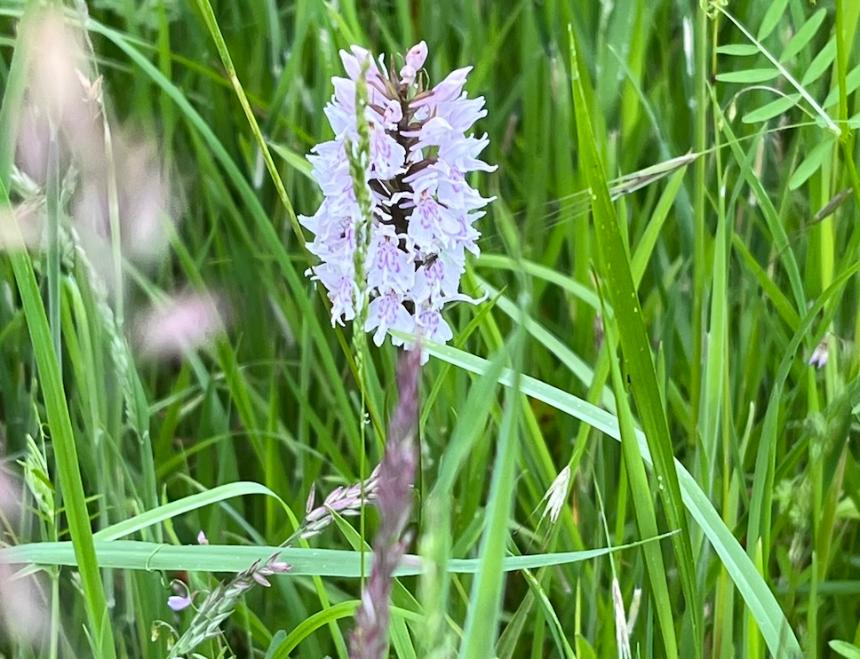
Common Spotted-orchid, Dactylorhiza fuchsii. Native. Occasional. Damp woodland and grassy places. An actively increasing population occurs on grassland which colonised bare clay.
Bee Orchid, Ophrys apifera. Native. Rare. Regularly seen on the perimeter bridleway of the airfield and on grassland within.
ADDITIONS MADE TO THE LIST ABOVE RESULTING FROM FURTHER OBSERVATIONS AND DISCOVERIES DURING THE YEARS 2001 TO 2025
Polypody, Polypodium vulgare agg. British. Rare. One plant naturalised on an old brick wall near Sackville Lodge, TL0413.6368. First noticed in 2021 and still present in October 2025. Unless I manage to examine it more critically this is best recorded as Polypodium vulgare agg.
Wall-rue, Asplenium ruta-muraria. British. Rare. Present on brickwork of road bridge over Riseley Brook, TL0348.6226, September 2025.
Norway Spruce, Picea abies. Introduction. Rare. In addition to various obviously planted trees in the village and in Lady Wood, several small specimens self-seeded into ground annually treated with herbicide, Rotten Row, TL035.626, c. 2005.
Riseley Goldilocks Buttercup, Ranunculus petaloideus A.C. Leslie, Native? Rare. TL039.630. No plants of this species have been identified by me but the type locality is in the parish, see: Fl. Gr. Brit. Ireland 1:676 (2018).
Californian Poppy, Eschscholzia californica. Introduction. Rare. Naturalised n cracks in pavement and beside wall at the small block of garages at the top of College Drive, TL0365.6261. Seen in 2024 and 2025.
Hop, Humulus lupulus. Native? Rare. Two large patches on the south-west side of Keysoe Road, TL0519.6206 and TL0505.6218, September 2025. Also overgrowing chainlink fence on the boundary between the Village Hall car park and the brook bank, TL0393.6265, November 2025.
Pellitory-of-the-wall, Parietaria judaica. British. Occasional. During the first decade of the 21st Century this appeared in some quantity beside pavements and in the vicinity of communal garages in Wells Road. In September 2025 it was found to be still common in the Wells Road area, TL0377.6260.
Betula spp. I am rather surprised that Betula was not mentioned in the previous survey. Betula occurs apparently naturally and in quantity in parts of Coppice Wood (outside the parish). Its presence should be checked for in Flints Wood and Lady Wood. Birch occurs as a planted tree within the village, for example a specimen which has reached a reasonable size near the Police Station. Birch also forms a significant component of the planting in Seven Acre Wood which is north-west of All Saints churchyard. So far (November 2025) I have not noted any occurrence of natural regeneration or seedlings arising from planted trees in the parish.
Grey Alder, Alnus incana. Introduction. Rare. A single occurrence, a long-established, formerly coppiced specimen beside the concrete track towards the east side of Flints Wood, TL041.642, September 2025.
Hornbeam, Carpinus betulus. British. Occasional. It is unlikely that this tree species was a native of the parish in historic times but it now occurs due to planting, including in hedgerows. One naturalised sapling has become established in the fenced footpath, leading south-west along the brook side from College Drive. This has presumably seeded from a tree in the adjacent garden, TL0369.6251, first noticed c. 2005,still present as a stunted tree in November 2025.
Common Chickweed, Stellaria media. Native. Frequent. Omitted by accident from the list in the previous survey. Remains rather frequent in the parish in places where the ground has been disturbed, perhaps most commonly in hand-cultivated ground in gardens and the allotments.
Four-leaved Allseed, Polycarpon tetraphyllum. British. Rare. Present as a single colony as a pavement weed in Brooklands Road, TL0370.6245, November 2025.
Red Campion, Silene dioica. British. Occasional. Presumably introduced but now (2020s) well-established to the south side of the brook, north of The Mallowry. This strip of grassland appears to have been sown with some sort of wildflower mixture, the most conspicuous species which have become established here are Cowslip, Red Campion and Ox-eye Daisy. This strip also has a Festuca species present in abundance which was also presumably part of the planting, TL0318.6225. An arable field south of Clay Mount has been planted (early 2020s) with a wildflower/grass mix in which the two most conspicuous species are Red Campion and Ox-eye Daisy (TL032.614).
Tall Tutsan, Hypericum x inodorum. Introduction. Rare. One well-established plant on the stone-filled gabions which form a revetment to Riseley Brook, Riseley High Street, TL0399.6269, November 2025. Identity should be checked next season.
Hollyhock, Alcea rosea. Introduction. Rare. Grown in a front garden in Rotten Row from which it has spread and become naturalised on the roadside and a nearby track, TL0357.6268, October 2025.
Sweet Violet, Viola odorata. Native. Occasional. A surprising omission from the previous survey, presumably an oversight. Despite its native status, Boon (2011) considers that in “many sites it has been introduced and readily becomes established and so it is not possible to give its true native distribution”. Present beside the botanically rich ditch which runs south-east to meet Dag Lane, TL033.631, September 2025. Also present beside the footpath which starts beside the former Royal Oak pub, the violets growing at the base of the wall of the brick barn, TL0437.6301, September 2025. Perhaps one of the more natural settings is on the perimeter bridleway leading north-east from the top of Galsey Lane, TL037.613, September 2025.
Common Dog-violet, Viola riviniana. British. Rare. A plant growing beside the tarmac footpath leading from the top of College Drive towards the back of The Bungalow in Rotten Row, perhaps of garden origin, TL0362.6258, May 2021.
Wavy Bitter-cress, Cardamine flexuosa. Native. Rare. Beside tarmac footpath leading from the top of College Drive towards the back of The Bungalow in Rotten Row, TL0361.6258.
Garden Cress, Lepidium sativum. Adventive. Rare. Near the Village Hall, close to the boundary of the adjacent thatched property, on a poorly vegetated slight bank. Garden Cress seeds are said to be a common component of bird seed mixes so this may be the origin of this occurrence, TL0387.6268, 1st November 2025.
Garden Radish, Raphanus sativus. Introduction. Rare. In an uncultivated, ex-arable field. A scatter of plants was present, perhaps arising from some environmental planting scheme, TL050.647, September 2025.
Reflexed Stonecrop, Sedum rupestre. Introduction. Rare. Growing in the sparse vegetation on stone-filled gabions forming revetment of Riseley Brook, opposite the Fox and Hounds public house, TL0392.6264, September 2025.
Giant Blackberry, Rubus armeniacus. Introduction. Occasional, perhaps becoming Frequent. Present in numerous patches, mainly within or close to the village, rare in the wider landscape. A particularly notable occurrence is the large stands dominating the banks of Riseley Brook between TL0411.6296 to TL0423.6305, September 2025.
Garden Lady’s-mantle, Alchemilla mollis. Introduction. Rare. Naturalised in pavement cracks in Brooklands Road, TL0370.6245, October 2025.
Bird Cherry, Prunus padus. British. Rare. Occurs in the parish as planted trees, several having been planted near the south-west edge of Seven Acre Wood, to the west of All Saints churchyard, TL0381.6325.
Cherry Laurel, Prunus laurocerasus. Introduction. Rare. Widely planted in the village. Several small specimens self-seeded into bare ground that was treated annually with herbicide, Rotten Row, TL0358.6266, c. 2005.
Firethorn, Pyracantha coccinea. Introduction. Rare. Small, self-seeded plant in rubble track, Rotten Row, perhaps bird sown from the regularly fruiting and long-established Firethorn bush in the adjacent cottage garden, TL0357.6268, 9th November 2025.
Crataegus sp. A curious black-berried hawthorn in an agricultural hedgerow which was planted in recent decades, the hedge strikes westwards from Melchbourne Road, TL0493.6427. Vegetatively this is like an exuberant, non- or very sparsely thorny C. monogyna but, in addition to the black berries, it has two styles and two seeds in the berries.
Dwarf Spurge, Euphorbia exigua. Status? Rare. First noticed in the parish around 2020 where it occurred as an occasional arable weed over an extensive area of several large arable fields either side of Lowsdon Lane, TL044.621.
Wood Spurge (subsp. robbiae), Euphorbia amygdaloides subsp. robbiae. Introduction. Rare. Beside the footpath which leads towards the brook from the former Royal Oak public house, TL0437.6301, 2021.
Shining Cranesbill, Geranium lucidum. British. Occasional. By May 2021 it had become abundant in a metre wide strip along the west edge of the concrete road of Carriage Drive throughout most of its route along the west edge of Flints Wood; still similarly abundant in 2025, TL0420.6392 to TL0386.6429.
Shepherd’s-needle, Scandix pecten-veneris. Native? Rare. Several dozen plants at the edge of an arable field beside the track to Coldham Lodge, TL049.635, c. 2005. An arable weed which is now rare throughout Britain although farming literature suggested an increase in occurrence during the first decade of the 21st Century.
Alexanders, Smyrnium olusatrum. Adventive. Rare. A large patch in the small wooded area between Riseley Brook and the entrance to Carriage Drive, TL0471.6345, was present throughout the second decade of the 21st Century. When searched for in September 2025 no trace could be found. Another search is required earlier in the season to determine whether this colony still exists.
Thorn-apple, Datura stramonium. Introduction. Rare. In vegetation arising where shrubs were removed in the last year or two in the communal amenity area to the south of the garages at the top of Dodds Close/Bowers Close, TL0454.6300, September 2025. Also arose spontaneously where a large front garden hedge had been removed in Riseley High Street, TL0451.6310, September 2025.
Nicotiana x sanderae. Introduction. Rare. Cultivated as an ornamental tobacco. Self seeded from nearby gardens into cracks beside the curb of Brooklands Road, TL037.624, date uncertain.
Common Gromwell, Lithospermum officinale. Native. Rare. First noticed in May 2021 in the grassy area within Lady Wood. Not recorded in the previous survey but presumably long established and occurring naturally here. Still present in September 2025 forming a sparse patch of several plants approximately two by three metres, TL0360.6443.
Lungwort, Pulmonaria officinalis. Introduction. Rare. Present as a pavement weed in Brooklands Road, TL0370.6245, November 2025.
Yellow Archangel, Lamiastrum galeobdolon subsp. argentatum. Introduction. Rare. Well established beside paths within the village, for example adjacent to the garden of 15 Rotten Row, TL0359.6270, September 2025. A sizeable colony is present at the north-west corner of Galsey Wood, TL0331.6125, September 2025. So far this has remained on the roadside side of the bridleway. Trampling on the bridleway may prevent its spread across into Galsey Wood itself.
Gypsywort, Lycopus europaeus. Native. Rare. In some quantity at the margins of a large pond, TL0473.6310, September 2025.
Garden Privet, Ligustrum ovalifolium. Introduction. Rare. Commonly planted as a garden hedging plant in the village. Two large, long-established clumps are present in a field hedge near Rotten Row, still present in September 2025, TL0346.6243.
Ivy-leaved Toadflax, Cymbalaria muralis. Introduction. Rare. Growing on a low front garden wall beside pavement, The Orchard (off Wells Road), TL037.626, 2021.
Round-leaved Fluellen, Kickxia spuria. Native. Occasional. Robust sprawling plants in an arable field on the south-west side of Keysoe Road, TL050.621, August 2021. Identified on account of its rounded leaf bases, pedicels entirely hairy and large flowers with purple upper lip.
Common Broomrape, Orobanche minor. Native. Rare. Several spikes, presumably parasitic on clover planted as a legume-rich ley (agricultural subsidised scheme), TL0444.6208, 2024.
Woodruff, Galium odoratum. British. Rare. A well-established patch on the brook bank opposite Riseley Police Station. The bank here was at one stage (early 2000s) temporarily managed as a small patch of ‘wildflower meadow’ and various species were introduced including perhaps this colony of Woodruff. TL0381.6256. First recorded here in 2021, still present in October 2025.
Himalayan Honeysuckle, Leycesteria formosa. Introduction. Rare. It appeared spontaneously in a garden in Rotten Row where it was left to grow as a novelty and for the pleasant taste of the ripe fruits. In September 2025 a self-set plant was found beside the footpath that links Beanfield Close to Rotten Row, TL0361.6269.
Keeled-fruited Cornsalad, Valerianella carinata. British. Rare. On the grass verge of Rotten Row, almost opposite The Bungalow. The verge here is in the form of a narrow bank and the vegetation becomes sparse in dry spells, TL0352.6260, May 2021.
Small Teasel, Dipsacus pilosus. Native. Rare. A single small clump was seen towards the north edge of Lady Wood, TL0359.6449, September 2025. This seems to be a considerable reduction of the colony since I first noticed it here in 2024 following felling operations; a survey earlier in the season is required to determine the current extent and abundance.
Salsify, Tragopogon porrifolius. Adventive. Rare. It appeared on former arable, set-aside land near the Old White Horse, TL0370.6232, c. 2025. In September 2025 a self-set colony was recorded in a rubble track, Rotten Row, TL0358.6268.
Great Lettuce, Lactuca virosa. Status? Rare. Present beside the footpath that leads from Riseley High Street (close to the village shop) ultimately to the church, TL0417.6291. First noted here in 2024. In September 2025 it was still present as a loose patch of three plants.
Mouse-ear-hawkweed, Pilosella officinarum. British. Rare. Extensively naturalised in a regularly short-mown front garden lawn, Rotten Row, TL0356.6270, September 2025.
Elecampane, Inula helenium. Introduction. Rare. An apparently long-established but not extensive colony on a ditch bank near Coldham Lodge Farm, TL0510.6332, September 2025.
Mexican Fleabane, Erigeron karvinskianus. Introduction. Rare. Naturalised in pavement cracks, apparently arising from a nearby informally grown garden colony, The Orchard, TL0373.6269, September 2025.
Guernsey Fleabane, Erigeron sumatrensis. Introduction. Occasional. Scattered but in some quantity in pavement cracks and in cracks of block paving of domestic drives, especially in College Drive, TL0370.6255, September 2025.
Bilbao Fleabane, Erigeron floribundus. Introduction. Occasional. Present as an extensive colony beside the cross-field bridleway near The Mallowry, presumably introduced with pot-grown laurel shrubs planted as future screening in the early 2020s, noted in some abundance between 2022 and 2025, TL0318.6223 to TL0319.6204. In September 2025 another colony was found in an area previously cleared of scrub beside Riseley Brook, TL0342.6226.
Argentine Fleabane, Erigeron bonariensis. Introduction. Rare. In pavement cracks towards the top of College Drive, near the communal garages, TL0365.6258, 9th November 2025. Subsequently also found on the pavement in Wells Road.
Tansy, Tanacetum vulgare. British. Rare. A large, long-established colony is present as a narrow roadside strip adjacent to the Village Hall car park, TL0388.6265, October 2025.
Winter Heliotrope, Petasites fragrans. Introduction. Rare. Well naturalised in front garden of thatched cottage in Church Lane and spreading to the edge of the adjacent footpath, TL0392.6297, 12th December 2025 (when it was just starting to flower).
Shaggy Soldier, Galinsoga quadriradiata. Introduction. Occasional. Rather frequent as a pavement weed along much of Brooklands Road, TL0370.6245, October 2025.
Broad-leaved Pondweed, Potamogeton natans. Native. Occasional. In quantity in a large pond, TL0473.6310, September 2025.
Bamboo, possibly Pseudosasa japonica. Introduction. Rare. A vigorous colony growing on top of the bank of Riseley Brook, beside the fenced footpath leading south along the west brook bank from College Drive, TL0369.6250, September 2025.
Oat, Avena sativa. Introduction. Rare. Occurring as a pathside weed, in cracked tarmac, within a housing estate (off College Drive), TL037.626, c. 2005.
Water Bent, Polypogon viridis. Introduction. Rare. Several plants growing on the roadside verge opposite the Village Hall car park, Gold Street, TL0386.6266, 15th December 2025.
Hybrid Bluebell, Hyacinthoides x massartiana. Introduction. Occasional. A rather large colony is present on the north road verge near the road bridge over Riseley Brook, TL0348.6227 where it has been present since at least May 2021. There is also another small clump some metres to the north at the top of the brook bank in coarse vegetation, giving the appearance as though it has spread from the roadverge colony. Other occurrences include: Just outside the west corner of the field ‘Clay Mount’ (TL0319.6163), the west end of Galsey Lane (TL0338.6140), the layby at the south-east corner of Keysoe Park Road (TL0528.6198), and also quite frequent on the south-east bank of Riseley Brook, to the north-east of the brick footpath bridge ‘behind’ the shop (TL0416.6299).
Ramsons, Allium ursinum. British. Rare. A considerable vigorous colony well-established on the bank of Riseley Brook adjacent to one of the gardens backing on to the brook from Brooklands Road, TL0363.6244, first noted in 2021.
Pale Yellow-eyed-grass, Sisyrinchium striatum. Introduction. Rare. Naturalised in pavement cracks along the footpath that links The Orchard and Wells Road, TL0371.6268, September 2025.
Stinking Iris, Iris foetidissima. British. Occasional. There are scattered occurrences within the village, most or all of which are presumably garden escapes. A fairly large colony of scattered individuals occurs on the hedgebank of Bowers Lane close to its junction with the High Street, TL0454.6311, September 2025.
Pyramidal Orchid, Anacamptis pyramidalis. Native. Rare. A single flowering spike was seen at the edge of the grass track to the west-north-west of Red House Farm, TL0283.6106, July 2021. A single flowering spike was noted on the road verge of Melchbourne Road, TL0484.6499, July 2025.